


What are the different types of carton box closures?
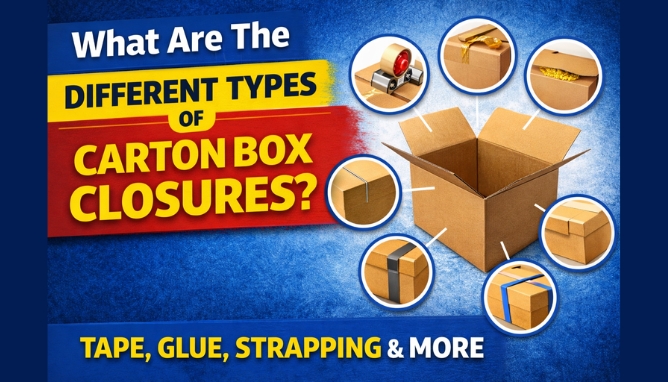
Closing a carton properly keeps products safe, controls cost, and improves the unboxing experience. There are many closure methods used across industries. Some are best for high speed automated lines. Some are chosen for reusability and presentation. Below I explain each major closure type, when to use it, how it performs, and important pros and cons so you can pick the right one for your product.
1. Tape closure
Tape is the most common way to seal corrugated cartons. It is fast, inexpensive, and easy to apply by hand or machine. Typical tapes include BOPP pressure sensitive tape, hot melt adhesive tape, reinforced filament tape, paper tape, and tamper evident tape. Tape works well for light and medium weight shipments, and it is the default choice for most e-commerce packing lines.
Pros
- Low cost and widely available.
- Easy to automate with case sealers.
- Tamper evidence options exist.
Cons
- Can fail if flaps were folded poorly or if environmental conditions are extreme.
- Some tapes do not adhere well to recycled corrugated or dusty surfaces.
Best use cases
- Standard single box shipping, consumer retail packs, and medium duty boxes.
2. Hot melt adhesive or glue closure
Many high speed packaging lines use hot melt glue to seal top and bottom flaps. Glue can be applied in dots, beads or full patterns. It gives a clean finish and strong bond when applied correctly. Flap gluing is also used at the factory when producing folding cartons so they arrive already closed or partially closed.
Pros
- Strong and fast bond on many substrate types.
- Works well in automated applications.
- Neater appearance than some tapes.
Cons
- Requires glue equipment and periodic maintenance.
- Some adhesives are sensitive to temperature and humidity.
Best use cases
- High throughput operations, retail ready packaging, and when a clean look is important.
3. Staple closure
Stapling uses metal staples to join flaps. It is a simple mechanical approach and has been used in industrial packing for decades. Heavy duty staples or clinch staples provide reliable closure for very heavy or bulky cartons that may be palletised and shipped long distances.
Pros
- Very strong for heavy loads.
- Fast for manual and semi-automatic applications.
Cons
- Not suitable for food or applications where metal contamination is a concern.
- Difficult to reuse and not visually refined.
Best use cases
- Industrial crates, building materials, and export cartons where mechanical strength is required.
4. Strapping or banding closure
Strapping uses plastic or steel straps around the box or pallet to secure contents. Straps may be plain polypropylene, polyester, or steel for very heavy shipments. Strapping is often used with corners, edge protectors, and in combination with palletisation for long distance transport.
Pros
- Excellent for heavy and unstable loads.
- Prevents shifting during transport.
Cons
- Requires strapping tools and consumables.
- Adds to cost and makes single box opening harder for consumers.
Best use cases
- Palletised loads, heavy machinery, building supplies, and export.
5. Self locking and interlocking closures
These are structural closure designs built into the carton. Examples are crash lock bottoms, 1-2-3 bottom closures, tuck top closures with locking tabs, and interlocking flap designs that require no tape or glue. Self locking cartons speed up packing and reduce material cost because no external sealing is needed.
Pros
- No additional sealing material required.
- Fast erection and good for retail presentation.
- Can be designed for reusability.
Cons
- Not always as secure as taped or strapped closures for very heavy or fragile shipments.
- Complexity of die cutting can raise carton costs.
Best use cases
- Retail gift boxes, subscription boxes, light to medium weight retail packs, and cases where speed of assembly matters.
6. Velcro, hook and loop, and reusable fasteners
Reusable closures like Velcro, snap buttons, magnetic closures, and hook and loop are used for premium boxes, sample kits, and storage packaging. They give a superior customer experience and can be opened and closed many times.
Pros
- Reusable and consumer friendly.
- Great for presentation and premium branding.
Cons
- Higher unit cost.
- Not suitable for high volume sealing where cost is critical.
Best use cases
- Gift boxes, premium electronics packaging, subscription box inner packaging.
7. Labels, stickers and tamper seals as closure aids
Labels and stickers can seal cartons lightly or be used as tamper evident seals. They are not always structural, but they are useful for branding, legal information, and showing if a package has been opened. Tamper evidence is important for pharmaceuticals and high value products.
Pros
- Good for branding and security.
- Low cost for light sealing.
Cons
- Not a structural sealing method on its own for heavy loads.
Best use cases
- E-commerce where a seal shows authenticity, or as an additional security layer over a tape or glue seal.
8. Combination closures
Many packers combine methods to match risk and cost. A typical heavy parcel might use tape plus strapping plus a tamper label. A retail box might use a self locking design reinforced with a thin strip of tape. Combining methods increases security and provides redundancy.
Pros
- Flexible and increases protection.
Cons
- More cost and more steps on the packing line.
How to choose the right closure method
- Product weight and fragility. Heavy or fragile products need mechanical strength like strapping or staples.
- Shipping distance and handling. Long overseas haul and repeated handling call for stronger closures.
- Speed and automation. High speed lines favor tape or hot melt glue.
- Presentation and reusability. Premium or subscription packaging often uses self locking, Velcro, or magnetic closures.
- Cost targets. Tape is often the cheapest per box for high volume. Hot melt glue has higher equipment costs but lower unit cost at scale.
Practical tips for better closure performance
- Always check the carton flaps are folded correctly before sealing. Poor flap folding is the most common cause of seal failure.
- Match tape type to carton board and environment. Use reinforced filament tape for heavy loads and water activated tape for recycled board.
- Where possible, test the full pack under expected handling conditions before shipping at scale.
- Consider edge protectors or corner boards when using strapping to prevent strap damage to the box and product.
Quick comparison table
| Closure | Strength | Cost | Automation | Best for |
|---|---|---|---|---|
| Tape | Medium | Low | Yes | E-commerce, retail |
| Hot melt glue | Medium-High | Medium | Yes | Automated lines, retail ready |
| Staple | High | Low-Medium | Semi | Heavy industrial loads |
| Strapping | Very High | Medium | Yes | Pallets, exports |
| Self locking | Medium | Low-Medium | Yes | Retail boxes, gift packs |
| Velcro / magnetic | Low-Medium | High | No | Premium packaging |
| Labels / seals | Low | Low | Yes | Tamper evidence, branding |
Final thought
There is no single best closure. The right choice balances strength, cost, automation, and the customer experience. For fast moving consumer goods use glue or tape on automated lines. For heavy exports combine strapping with tape or staples. For premium products choose self locking and reusable closures. Test on real shipments and tune the method to suit your product and supply chain.